
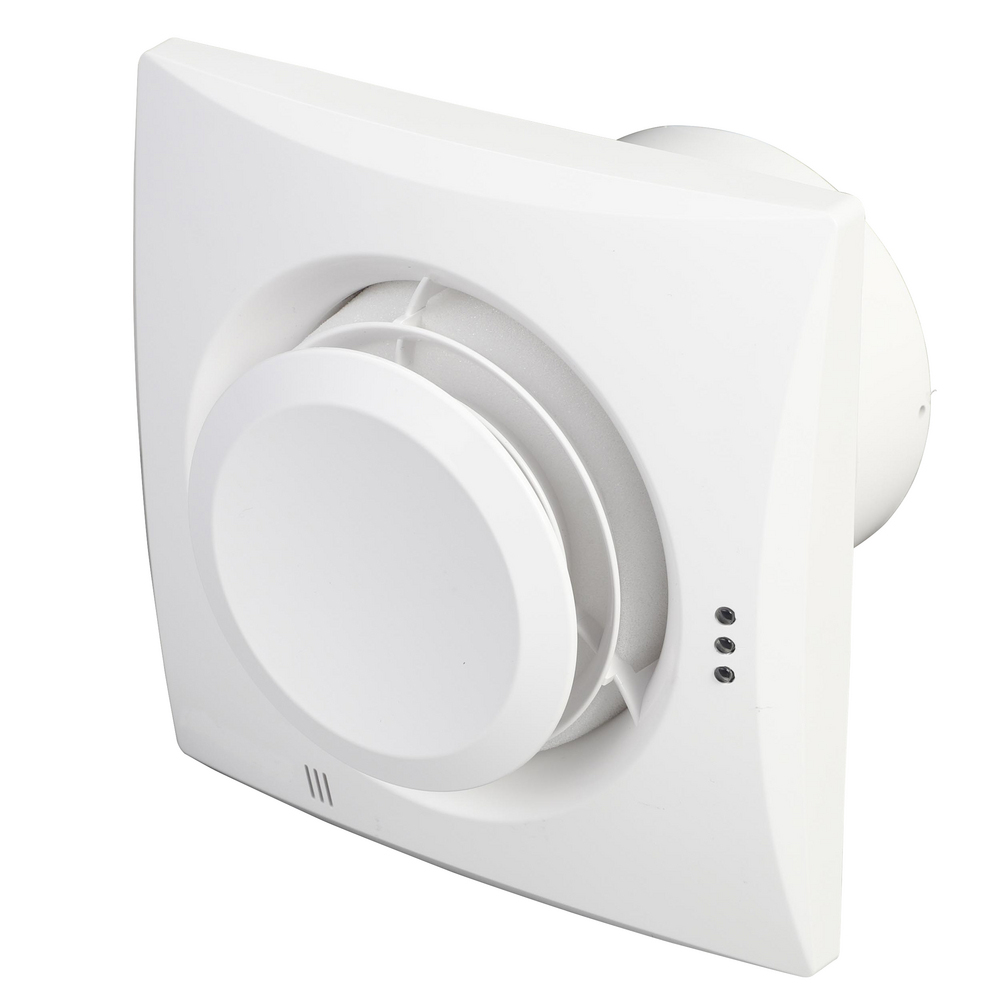
How to Choose the Right Bathroom Extractor Fan
Every time you take a shower or run a bath, your bathroom fills with warm, moisture-laden air. Without adequate ventilation, that moisture has nowhere to go, it condenses on cool surfaces like walls, mirrors, and ceilings. Over time, this leads to black mould, peeling paint, structural dampness, and persistent musty odours that no amount of cleaning will shift.
A properly specified bathroom extractor fan removes humid air from the room before it condenses, drawing in drier replacement air from adjacent spaces. It’s one of the simplest, most cost-effective upgrades you can make to any bathroom.
This guide walks you through everything you need to know: extraction rates, fan types, IP ratings, UK building regulations, and exactly which features will make a real difference day to day.
Why Bathroom Ventilation Matters
Excess moisture in bathrooms is one of the leading causes of mould, peeling paint, and persistent condensation in UK homes. Without proper airflow, moisture from showers and baths lingers in the air and, over time, causes:
- Black mould growth — a health hazard, particularly for those with respiratory conditions
- Peeling paint and wallpaper — expensive and unsightly to repair
- Swollen timber and damaged sealants around baths and showers
- Persistent musty odours
- Structural dampness — the long-term enemy of any property
A bathroom extractor fan draws humid air out through ducting to the exterior of the building, while drawing in drier replacement air from adjacent spaces. It’s a simple, energy-efficient solution that prevents all of the above.
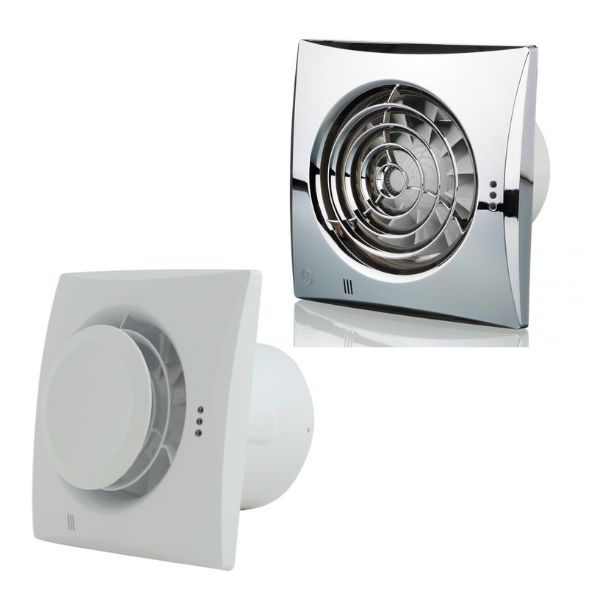
Understanding Extraction Rates & UK Part F Regulations
The extraction rate — how much air a fan moves per unit of time — is the single most important specification when choosing a bathroom extractor fan. It’s measured in litres per second (l/s) or cubic metres per hour (m³/h).
What UK Part F Regulations Require
Under the UK Government’s Approved Document F (ventilation), a bathroom extractor fan must provide a minimum intermittent extract rate of 15 litres per second (54 m³/h). This applies to bathrooms, shower rooms, and WCs with a shower.
This is a minimum, not a target. For larger family bathrooms, en-suites used multiple times daily, or rooms with long or complex duct runs, you may need a stronger fan to provide adequate airflow.
How Room Size and Duct Length Affect the Calculation
A useful rule of thumb: your fan should be capable of replacing the air in the room with 3–8 air changes for a bathroom and 6–20 for a bathroom with a shower (CIBSE Guidelines). For a typical bathroom of around 8m³, that works out at roughly 7–18 l/s for 3–8 air changes. Any bends or extended duct runs reduce the effective airflow the fan can deliver — more on this in the ducting section below.
Types of Bathroom Extractor Fan
Not all extractor fans are created equal. The right type depends largely on where you need to duct the air and how far it needs to travel.
Axial Fans — Best for Short, Direct Duct Runs
Axial fans are the most common type and the simplest in design. The motor spins an impeller that pushes air in a straight line along the axis of the fan. They’re compact, affordable, and easy to install — but their performance drops off significantly if the duct is too long or has too many bends.
Best suited for: bathrooms where the duct run is short and relatively straight — typically no more than 2 metres with up to two 90° bends, or directly through the wall.
Centrifugal Fans — For Medium Duct Lengths
Centrifugal fans use a different mechanism: air enters through the front grille, like an axial fan, but is thrown outward by centrifugal force, giving the fan greater ability to overcome duct resistance.
Best suited for: duct runs up to around 6 metres with up to two 90° bends.
Please enquire — centrifugal fans available on request.
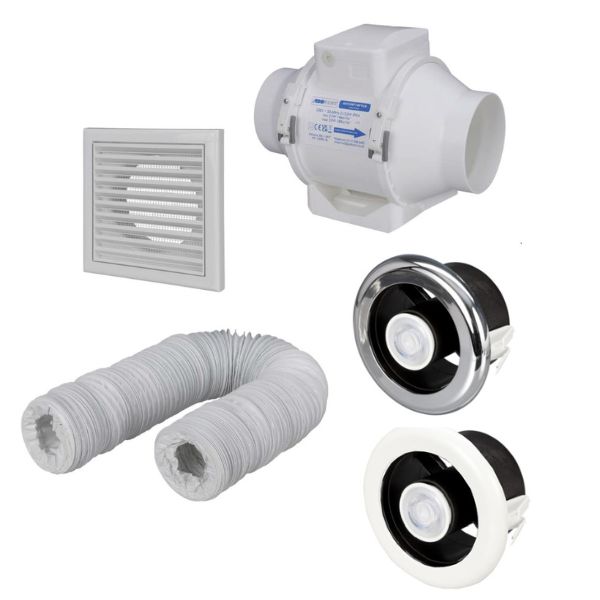
Inline / Mixed-Flow Fan Kits — For Long or Complex Duct Runs
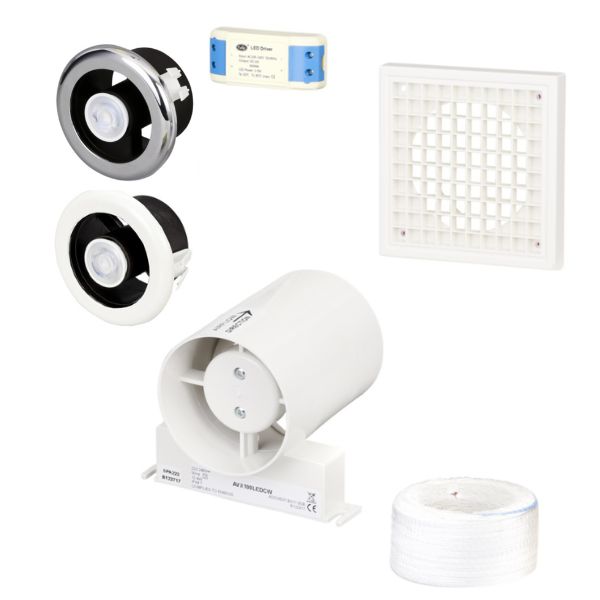
Inline fans are installed within the ductwork itself, typically in a loft space, rather than directly in the bathroom ceiling or wall. A decorative grille in the bathroom is all that’s visible, making them extremely discreet. Mixed-flow technology combines axial and centrifugal principles, giving excellent airflow even through long, complex duct routes.
Best suited for: duct runs up to 10 metres, loft installations, situations where ultra-quiet operation is required, or over-shower extraction paired with a separate light grille.
- Richmond 100MM Timer Shower Fan Extractor Kit — ideal for standard bathrooms with medium duct runs.
- Knightsbridge 100MM In-Duct Mixed Flow Kit With Timer — the go-to for longer duct runs up to 10 metres.
Key Features to Look For
Once you’ve identified the right fan type, the features you choose will determine how convenient, effective, and energy-efficient your ventilation is day to day.
Timer Function — Why Overrun Matters
A built-in overrun timer allows the fan to continue running for a set period after the bathroom light is switched off. This is crucial: most condensation damage is caused by lingering moisture on surfaces that can then be absorbed into dry plasterboard walls and ceilings.
Most bathroom fan timers are adjustable from 2 to 30 minutes. A 15-minute overrun is a sensible starting point for most bathrooms. Without a timer, a fan that cuts off with the light will clear only a fraction of the moisture produced by a shower.
Camden 100MM Shower Fan Extractor With Timer — reliable shower extraction with adjustable overrun timer.
Humidity Sensor (Humidistat) — Smart, Automatic Ventilation
A humidistat-equipped fan monitors the relative humidity in the room and activates automatically when levels rise above a set threshold — typically 70–80% RH. This means you don’t need to remember to switch the fan on, and it continues running until the room is properly dried out.
Humidistat fans are particularly effective in family bathrooms with heavy daily use, and in en-suites where the fan might otherwise be forgotten.
Hampton 100MM Zone 1 Humidity Timer Extractor Fan — intelligent automatic ventilation with combined humidity sensor and timer. Zone 1 rated for installation directly above baths and showers.
Integrated LED Light — Two Functions in One
Combining an extractor fan with a recessed LED light is an increasingly popular choice — particularly for shower enclosures and ceiling installations where space is at a premium. Fan-light combination units eliminate the need for a separate ceiling fitting above the shower, keeping the design clean and reducing the number of penetrations in the ceiling void.
- Richmond LED 100MM Timer Shower Fan Extractor Kit With LED — shower fan extractor with integrated LED light and adjustable timer.
- Portobello LED 100MM In-Duct Fan Kit With LED & Timer — in-duct system with LED grille, ideal for over-shower applications with longer duct runs.
- Knightsbridge LED 100MM Mixed Flow LED Shower Light Kit — premium mixed-flow extraction with integrated LED shower light for demanding installations.
Noise Levels — What dB to Look For
Bathroom fan noise is measured in decibels (dB). For en-suites adjacent to bedrooms, or for night-time use, look for fans rated at 30 dB or below. Inline fans, where the motor sits remotely in the loft space, are often the quietest solution of all, as all mechanical noise is kept well away from the room.
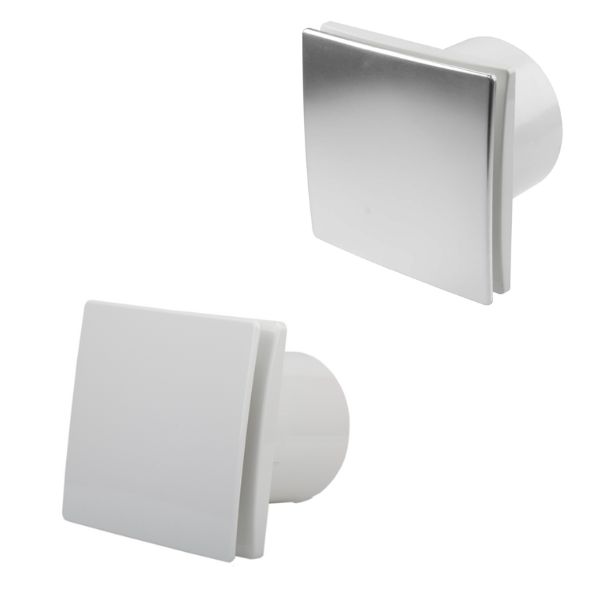
IP Ratings & Bathroom Zones Explained
Bathrooms are classified into zones based on their proximity to water sources. These zones dictate the minimum IP (Ingress Protection) rating that any electrical fitting — including extractor fans — must carry to be safely and legally installed there.
Zone 0 — Inside the bath or shower itself. Fans are not typically installed here. Any fitting must be low voltage and IPX7 rated as a minimum.
Zone 1 — The area above the bath or shower up to 2.25 metres from the top of the bathtub or shower cubicle. A minimum of IPX4 is required here, with IPX5 often preferred in practice.
Zone 2 — The area extending 0.75m upwards and 0.6m horizontally beyond Zone 1, up to 2.25 metres from the floor. IPX4 is the minimum requirement. RCD protection on the circuit is essential.
Outside Zones — Fewer restrictions apply, but good practice still recommends appropriate moisture-resistant fittings in any bathroom environment.
| IP Rating | Water Protection | Suitable Zones |
|---|---|---|
| IPX4 | Direct water spray from all directions | Zone 1, Zone 2 |
| IPX5 | Low pressure water jets from all directions | Zone 1 (preferred), Zone 2 |
| IP65 | Total dust protection + low pressure water jets | Zone 1, Zone 2 |
| IP67 | Total dust protection + immersion 150–1000mm | Zone 0 |
Always check the IP rating on the product datasheet before purchasing. Installing a fan with an insufficient IP rating in the wrong zone is both a safety risk and a Building Regulations violation.
Ceiling, Wall or Inline — Where Should You Install Your Fan?
Ceiling installation is the most common and most discreet option. Ducted via the ceiling void or loft space to an external wall or soffit, a ceiling fan can be positioned directly above or close to the shower — the main source of moisture. This is the preferred position for most modern bathrooms.
Wall installation suits bathrooms where ceiling access is impractical or where an external wall is immediately adjacent to the shower. The fan vents directly through the wall with minimal ductwork, making it a straightforward option for through-wall applications. A Wall Grille Kit at the external termination point completes the installation.
Inline installation places the fan motor remotely within the duct run — usually in a loft — while a grille sits flush in the bathroom ceiling. This is the quietest possible arrangement and supports longer duct runs.
How Long Can You Run Bathroom Ducting?
Duct length is one of the most commonly overlooked factors when choosing a bathroom extractor fan. The longer and more complex the duct run, the more resistance the fan has to overcome — and the less airflow it can achieve.
| Fan Type | Max Recommended Duct Length | Max 90° Bends |
|---|---|---|
| Axial fan | ~2 metres | ~2 |
| Centrifugal fan | ~6 metres | 2 |
| Inline / Mixed-flow fan | Up to 10 metres | 2–4 |
Every 90° bend is roughly equivalent to adding an extra metre of straight duct in terms of resistance. If your duct route has multiple bends and a total run longer than 2 metres, an axial fan is likely to underperform — consider a mixed-flow kit instead.
Our Recommended Bathroom Extractor Fans
TLW Global stocks a carefully selected range of bathroom extractor fans under the Mark Lighting brand, designed for the KBB trade. Here’s a quick overview:
- Best for standard bathrooms: Camden 100MM Shower Fan Extractor With Timer — Reliable performance with overrun timer. Straightforward installation for most bathroom setups.
- Best for over-shower extraction with timer: Richmond 100MM Timer Shower Fan Extractor Kit— Designed specifically for shower environments. Adjustable overrun timer, quiet operation.
- Best for automatic humidity control: Hampton 100MM Zone 1 Humidity Timer Extractor Fan — Intelligent automatic operation via humidity sensor. Zone 1 rated.
- Best fan + light combination: Richmond LED 100MM Timer Shower Fan Kit With LED — Integrated LED light and extractor in a single ceiling unit.
- Best for long duct runs: Knightsbridge 100MM In-Duct Mixed Flow Kit With Timer — Handles duct runs up to 10 metres. The professional’s choice for complex or loft-based installations.
- Best premium fan + light for long runs: Knightsbridge LED 100MM Mixed Flow LED Shower Light Kit — Top-of-range solution combining powerful mixed-flow extraction with an integrated LED shower light.
Browse the full bathroom ventilation range at TLW Global.
Bathroom Extractor Fan – FAQs
Do I need an extractor fan if my bathroom has a window?
Technically no — an extract fan is not required if a window provides suitable natural ventilation. Ventilation may be delivered through natural ventilation, mechanical ventilation or a combination of both.
How many litres per second does a bathroom extractor fan need in the UK?
Part F requires a minimum intermittent extract rate of 15 litres per second (54 m³/h) for domestic bathrooms.
What is the maximum ducting length for a bathroom extractor fan?
It depends on the fan type: axial fans suit runs up to approximately 2 metres; centrifugal fans up to 6 metres; and inline or mixed-flow fans can handle up to 10 metres. Remember that each 90° bend adds the equivalent of around 1 metre of additional resistance.
How long should a bathroom extractor fan run after the shower?
Most timer-equipped fans offer an adjustable overrun of between 2 and 30 minutes. A 15-minute overrun is a sensible default for most standard bathrooms.
Can I install a bathroom extractor fan myself?
In the UK, connecting a bathroom extractor fan to a mains electrical circuit is notifiable work and must be carried out by a qualified registered electrician. The ductwork installation may be manageable for a competent DIYer, but the electrical connection should always be made by a professional.
What IP rating does a bathroom extractor fan need?
It depends on the zone. In Zone 1 (above the bath or shower up to 2.25m from the floor), a minimum of IPX4 is required — IPX5 is often preferred. In Zone 2 (0.6m beyond Zone 1), IPX4 is the minimum. Always check the product datasheet and ensure RCD protection is fitted on the circuit.


 and then